# Etsy Tags Guide — How to Choose the Best 13 Tags for Your Listings
Tags are one of the most misunderstood features on Etsy. Some sellers leave half their slots empty. Others stuff them with single words like "art" or "gift." A few repeat the exact same phrases already in their title, wasting precious real estate.
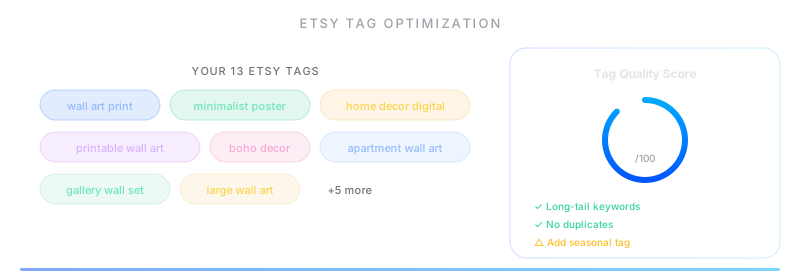
Meanwhile, Etsy gives you exactly 13 tag slots per listing. Each one is a separate chance for a buyer to find your product. That's 13 search queries you can target — and most sellers squander at least half of them.
This guide will show you exactly how Etsy uses tags, how to research the right ones, and how to fill all 13 slots with tags that actually drive traffic. We'll include concrete examples for three popular niches so you can see the strategy in action.
Why Tags Matter More Than You Think
Etsy's search algorithm (called "Etsy Search") decides which listings appear when a buyer types a query. Tags are one of the primary ranking factors, alongside your title, listing quality score, and shop history.
Here's the critical thing most sellers miss: tags and titles work together, but they serve different purposes.
Your title is what the buyer reads. It needs to be clear, descriptive, and compelling enough to click. Your tags, on the other hand, are invisible to the buyer — they exist purely for Etsy's search engine. This means your tags can include phrasing that would look awkward in a title but matches how real buyers search.
For example, a buyer might search for "gift for mom birthday" — that's not a phrase you'd put in your title, but it's a perfect tag.
Every empty tag slot is a missed search query. Every tag that duplicates your title is a wasted opportunity. And every single-word tag is competing against millions of listings instead of targeting a specific buyer.
How Etsy Uses Tags in Search
Before you start picking tags, you need to understand the mechanics.
Exact Match vs. Broad Match
Etsy uses two types of matching:
- Exact match — The buyer's search query matches your tag word-for-word. A search for "minimalist wall art" matches the tag
minimalist wall artperfectly. Exact matches get a ranking boost. - Broad match — Etsy breaks the query into individual words and looks for partial overlaps. A search for "minimalist wall art" could match a tag like
minimalist posterorwall art print. Broad matches still work, but with less ranking weight.
The takeaway: Use multi-word phrases as tags whenever possible. A tag like minimalist wall art covers the exact match AND the broad matches for "minimalist," "wall art," and "minimalist poster" (through word combination).
Tags Are Not Case-Sensitive
Vintage Poster and vintage poster are identical to Etsy. Don't waste mental energy on capitalization.
Tag Length Limit
Each tag can be up to 20 characters. This is tight — you need to be strategic. "Personalized birthday gift for her" won't fit. But "birthday gift for her" (21 characters) is one character too long. You'd need to shorten it to "birthday gift for him" (21 — still too long) or "gift for her birthday" (21 — also too long). In practice, you'd use "gift for her" (12 characters) and "birthday gift" (13 characters) as two separate tags.
Plurals and Synonyms
Etsy handles basic plurals automatically. "Poster" matches "posters" and vice versa. You don't need both. However, Etsy does NOT automatically match synonyms. "Mug" and "cup" are treated as different words. If buyers use both terms, you need both as tags.
The 13-Tag Strategy: Step by Step
Step 1: Research What Buyers Actually Search
This is the most important step, and the one most sellers skip. You need to know the actual phrases buyers type into Etsy's search bar — not what you think they search for.
Free methods:
- Etsy search bar autocomplete — Start typing a word related to your product and see what Etsy suggests. These suggestions are based on real search volume. If you sell travel posters and type "travel poster," you might see "travel poster vintage," "travel poster city," "travel poster personalized." Each suggestion is a proven search term.
- eRank (free tier) — The keyword explorer shows estimated search volume and competition for any phrase. Search for your main keyword and look at the "related keywords" section. This is gold.
- EverBee — Their Chrome extension shows estimated monthly searches for keywords directly on Etsy. Useful for validating whether a tag has real traffic.
Paid methods:
- eRank Pro ($5.99-$29.99/month) — Deeper keyword data, trend tracking, and competitor tag analysis.
- Sale Samurai ($9.99/month) — Shows search volume, competition scores, and long-tail suggestions.
- Alura ($29.99-$69.99/month) — AI-powered keyword suggestions and competitor tracking.
Spend 10-15 minutes on research per listing. It sounds like a lot, but these tags can drive traffic for months or years.
Step 2: Think Like the Buyer
Sellers describe their products using maker language. Buyers use everyday language. These are often very different.
A jewelry maker might think of their product as a "sterling silver minimalist cuff bracelet." A buyer might search for:
- "simple silver bracelet"
- "thin silver cuff"
- "everyday bracelet"
- "dainty silver jewelry"
- "gift for girlfriend"
Write down 20-30 phrases a buyer might use to find your product. Include different angles: the product type, the occasion, the recipient, the style, the material, the room it goes in, the problem it solves.
Step 3: Mix Broad and Specific Tags
Your 13 tags should cover a range of specificity:
- 2-3 broad tags — High traffic, high competition. You probably won't rank on page 1 for these, but they contribute to Etsy understanding what your product is. Examples: "wall art," "poster print," "home decor."
- 5-7 mid-tail tags — Moderate traffic, moderate competition. These are your workhorses. Examples: "vintage travel poster," "city wall art," "retro print."
- 3-5 long-tail tags — Lower traffic, lower competition. These are where new or smaller shops can actually rank. Examples: "Paris travel poster art," "kitchen wall decor gift," "boho nursery print."
Step 4: Don't Repeat Words From Your Title (Mostly)
Etsy already indexes your title words for search. If your title is "Vintage Paris Travel Poster — Retro City Wall Art Print," then Etsy already knows your listing is about "vintage," "Paris," "travel," "poster," "retro," "city," "wall art," and "print."
Using the tag vintage Paris poster is partially redundant. Those words are already indexed from your title.
The exception: If a specific multi-word phrase is a high-volume exact-match search term, it's worth using as a tag even if some words appear in your title. "Paris wall art" as a tag is valuable because buyers search that exact phrase, and the exact-match boost matters.
The rule of thumb: Prioritize tags that introduce NEW words not already in your title. This maximizes the total number of search queries your listing can appear in.
Step 5: Use All 13 Slots — Always
There is zero downside to using all 13 tags. An unused slot is a search query you're not targeting. Even if your 13th tag only brings in one extra view per week, that's 52 views per year you wouldn't have had.
If you're struggling to fill all 13, go back to Step 2 and think about more buyer angles: occasions (Christmas, Mother's Day, housewarming), recipients (gift for him, teacher gift), rooms (bedroom decor, office wall art), styles (boho, minimalist, maximalist, mid-century modern).
Step 6: Analyze and Iterate
Tags are not "set and forget." Check your Etsy stats monthly to see which search terms are driving traffic. If a tag isn't generating any views after 30 days, replace it. Seasonal tags (like "Christmas gift" or "Valentine's Day") should be rotated in and out.
Etsy's own Stats dashboard (under Shop Manager > Stats > Search terms) shows you the exact queries buyers used to find your listings. This is your most reliable data source.
Concrete Examples: 13 Optimized Tags for 3 Niches
Example 1: Vintage Travel Poster (Paris)
Title: "Paris Travel Poster — Vintage France Wall Art, Retro City Print"
Tags (13):
| # | Tag | Strategy |
|---|---|---|
| 1 | French wall art | New keyword "French" |
| 2 | Europe travel print | New keywords "Europe" |
| 3 | city skyline poster | New keywords "skyline" |
| 4 | apartment wall decor | Room-specific |
| 5 | housewarming gift | Occasion |
| 6 | dorm room art | Audience-specific |
| 7 | gallery wall print | Style |
| 8 | Eiffel Tower art | Landmark-specific |
| 9 | wanderlust poster | Lifestyle keyword |
| 10 | mid century modern | Style trend |
| 11 | living room art | Room-specific |
| 12 | gift for traveler | Recipient |
| 13 | colorful wall art | Attribute |
Why this works: The title already covers "Paris," "travel," "poster," "vintage," "France," "wall art," "retro," "city," and "print." The tags introduce 13 new angles — landmarks, rooms, occasions, recipients, and styles — that the title doesn't cover. Together, the title and tags target 25+ distinct search queries.
Example 2: Handmade Silver Ring (Minimalist Jewelry)
Title: "Minimalist Silver Ring — Thin Stacking Band, Dainty Everyday Jewelry"
Tags (13):
| # | Tag | Strategy |
|---|---|---|
| 1 | simple ring | Buyer language |
| 2 | delicate ring band | Synonym for "thin" |
| 3 | gift for her | Recipient |
| 4 | sterling silver ring | Material-specific |
| 5 | bridesmaid gift | Occasion |
| 6 | layering ring | Use case (synonym for stacking) |
| 7 | midi ring | Product variation |
| 8 | anniversary gift | Occasion |
| 9 | thumb ring women | Product variation |
| 10 | boho jewelry | Style |
| 11 | promise ring | Occasion |
| 12 | rings for women | Broad catch-all |
| 13 | birthday gift | Occasion |
Why this works: Jewelry buyers search by occasion more than any other niche. Four of the 13 tags target specific gift-giving moments. The rest introduce synonyms ("simple" vs. "minimalist," "delicate" vs. "dainty," "layering" vs. "stacking") and product variations (midi ring, thumb ring) that the title doesn't mention.
Example 3: Digital Download (Budget Planner Spreadsheet)
Title: "Budget Planner Spreadsheet — Monthly Finance Tracker, Google Sheets Template"
Tags (13):
| # | Tag | Strategy |
|---|---|---|
| 1 | expense tracker | Synonym for budget planner |
| 2 | money management | Broad concept |
| 3 | personal finance | Category keyword |
| 4 | savings tracker | Related product |
| 5 | bill tracker | Related product |
| 6 | digital planner | Format keyword |
| 7 | financial planner | Synonym |
| 8 | budget template | Buyer search phrasing |
| 9 | paycheck budget | Specific method |
| 10 | debt tracker | Related need |
| 11 | Excel spreadsheet | Platform variation |
| 12 | new year planner | Seasonal |
| 13 | instant download | Format reassurance |
Why this works: Digital download buyers often search by the problem they're trying to solve ("debt tracker," "bill tracker," "savings tracker") rather than the product type. The tags cover multiple financial pain points, two software platforms (Google Sheets is in the title, Excel is in the tags), and a seasonal hook.
5 Common Tag Mistakes (and How to Fix Them)
Mistake 1: Single-Word Tags
Tags like "art," "jewelry," or "gift" are almost useless. They match millions of listings, and you'll never rank for them. Always use multi-word phrases.
Fix: Turn "art" into "boho wall art." Turn "jewelry" into "handmade silver jewelry." Turn "gift" into "gift for best friend."
Mistake 2: Copying Your Title Into Tags
If your title says "Watercolor Floral Print," using the tag watercolor floral print wastes a slot. Etsy already indexes those words from your title.
Fix: Use tags to introduce words that AREN'T in your title. "Botanical wall art," "flower painting," "nature print" all expand your reach.
Mistake 3: Using Irrelevant Trending Tags
Adding "Barbie" or "Taylor Swift" to your vintage lamp listing won't help. Etsy's algorithm tracks whether buyers who click your listing actually buy. If they bounce because the listing isn't what they expected, your listing quality score drops — and you'll rank worse for ALL searches.
Fix: Only use tags that accurately describe your product or the buyer's intent. Relevance beats trend-chasing every time.
Mistake 4: Leaving Slots Empty
Many Etsy listings don't use all 13 available tag slots, according to various seller community analyses. Every empty slot is a forfeited search query.
Fix: Use the "think like the buyer" exercise from Step 2. Consider occasions, recipients, rooms, styles, colors, materials, and use cases. You'll find 13 tags easily.
Mistake 5: Never Updating Tags
Search trends change. Trends like "Cottagecore" that peaked a few years ago may have declining search volume. Tags that worked two years ago might be underperforming now.
Fix: Review your Etsy Stats quarterly. Replace underperforming tags with fresh keywords. Rotate seasonal tags (add "Christmas gift" in October, remove it in January).
Tools That Help With Tag Research
No tool is mandatory — you can do solid tag research with Etsy's search bar alone. But these tools save time, especially if you manage dozens or hundreds of listings.
eRank (Free — $29.99/month)
The gold standard for Etsy keyword research. The free tier gives you access to the keyword explorer, listing audit, and trend data. The paid tiers add deeper analytics, competitor tracking, and bulk audit tools. If you're only going to use one tool, start here.
Best for: Keyword research, listing audits, understanding search volume.
Sale Samurai ($9.99/month)
A focused keyword research tool with a Chrome extension that overlays search data directly on Etsy. Shows estimated search volume, competition level, and click rates. Particularly useful for finding long-tail keywords that eRank might miss.
Best for: Long-tail keyword discovery, competition analysis.
Alura ($29.99 — $69.99/month)
An all-in-one Etsy tool that includes AI-powered keyword suggestions. You enter your product type and Alura generates tag recommendations based on search data. The AI suggestions are a good starting point, though you should always validate them against actual search volume.
Best for: Sellers who want AI-assisted tag generation and are willing to pay for an all-in-one suite.
EverBee (Free — $29.99/month)
Primarily an analytics tool, but the Chrome extension shows estimated monthly searches for keywords when browsing Etsy. Useful for quick validation — hover over a competitor's listing to see which tags are driving their traffic.
Best for: Competitive research, quick keyword validation.
FluxCrea (Coming Soon)
FluxCrea is building AI-powered tag optimization into its listing management tool. The goal is to analyze your existing tags, suggest improvements based on search data, and let you apply optimized tags across multiple listings in bulk. It's currently in development — you can join the waitlist to get early access.
Best for: Sellers who want tag optimization integrated into their bulk editing workflow.
Frequently Asked Questions
Do tags affect Etsy Ads?
Yes. Etsy Ads uses your tags (along with your title, category, and attributes) to determine which search queries trigger your ads. Better tags mean your ads show up for more relevant searches, which typically improves your return on ad spend.
Should I use the same tags on every listing?
No. Each listing should have tags tailored to that specific product. Using identical tags across all listings means your own products compete against each other for the same search queries. Diversify your tags so each listing targets different buyer searches.
Can I use branded terms (like "Pottery Barn style") in tags?
Technically, you can use descriptive style references, but Etsy's policies prohibit using trademarked brand names to mislead buyers. "Pottery Barn style" is a gray area — some sellers use it without issues, others have had listings flagged. A safer alternative is to describe the style directly: "modern farmhouse," "rustic industrial," "coastal decor."
How long does it take for new tags to start working?
Etsy re-indexes your listing within a few hours of saving changes. However, it can take 1-2 weeks for the algorithm to fully evaluate your listing's performance with the new tags. Don't change tags daily — give them at least 2-4 weeks before judging results.
Do attributes (like color, material, occasion) replace tags?
No. Attributes and tags serve different purposes. Attributes help Etsy categorize your listing in filtered search results (when a buyer selects "Color: Blue" in the sidebar). Tags help your listing appear in open search queries. You should fill out both — attributes don't count against your 13 tag slots.
Start Optimizing Today
Tags are one of the highest-leverage changes you can make to an Etsy listing. They cost nothing, take 15 minutes per listing, and can meaningfully increase your search visibility.
Here's your action plan:
- Audit your top 10 listings — Check how many tag slots you're using. Fill any empty slots.
- Remove single-word tags — Replace them with multi-word phrases.
- Remove title duplicates — Swap any tags that repeat your title for new keyword angles.
- Research 5 new long-tail keywords — Use Etsy autocomplete or eRank's free tier.
- Set a calendar reminder — Review and refresh your tags every 3 months.
Related Articles
- How to Optimize Your Etsy SEO in 2026 — Complete Guide
- Best Etsy SEO Tools in 2026
- Etsy Listing Optimization Checklist (2026)
If you manage a large catalog and want to streamline this process, FluxCrea is building tools to analyze and optimize tags across hundreds of listings at once. Join the waitlist at fluxcrea.com/coming-soon to get early access when it launches.