# How to Optimize Your Etsy SEO in 2026 — Complete Guide
If you run an Etsy shop, you already know the frustration: you spend hours creating a beautiful product, write what you think is a decent listing, and then... crickets. No views, no favorites, no sales. Meanwhile, shops selling similar items are racking up thousands of orders.
The difference, more often than not, is Etsy SEO.
Search is the number one way buyers discover products on Etsy. According to Etsy's own seller handbook, the majority of purchases begin with a search query typed into that little bar at the top of the page. If your listings don't show up when someone searches for what you sell, you're invisible — no matter how good your products are.
This guide walks you through every lever you can pull to improve your Etsy search rankings in 2026. Every recommendation here is actionable and free to implement. No fluff, no gatekeeping.
Why Etsy SEO Matters More Than Ever
Etsy has over 85 million active buyers and around 5.6 million active sellers. Competition has never been fiercer. The platform processes hundreds of millions of searches every month, and the vast majority of clicks go to listings on the first page of results.
Here's what the data tells us:
- Listings on page one receive roughly 80-90% of all clicks for a given search query.
- The top 3-5 results capture the lion's share of those clicks.
- Etsy search is the primary traffic source for most shops — more than social media, direct links, or Etsy Ads combined.
In practical terms, moving from page three to page one for a moderately competitive keyword can mean the difference between 2 views per week and 200. That's not an exaggeration — it's the reality of how search-driven marketplaces work.
The good news: Etsy's algorithm is not a black box. Etsy has been increasingly transparent about how search works, and there are clear, repeatable strategies that work.
How the Etsy Search Algorithm Works
Before diving into tactics, you need to understand what Etsy's search engine actually does. It operates in two phases:
Phase 1: Query Matching
When a buyer types "minimalist cat poster," Etsy scans its entire catalog for listings that contain those keywords. It looks at your title, tags, categories, and attributes. If your listing doesn't contain the words the buyer searched for, it won't appear in results. Period.
This is the foundation: you must use the words your buyers are searching for.
Phase 2: Ranking
Once Etsy has a pool of matching listings, it ranks them. The ranking factors include:
- Relevancy — How closely your keywords match the search query. Exact matches and phrase matches rank higher than scattered keywords.
- Listing quality score — Etsy tracks how often people click on, favorite, and purchase your listing relative to how often it's shown. A high conversion rate signals quality.
- Recency — Newly listed or recently renewed listings get a temporary boost.
- Shop quality — Your overall shop score, including reviews, completion rate, and policy compliance.
- Shipping price — Listings with free shipping or competitive shipping costs rank higher, especially in the US market.
- Personalization — Etsy tailors results to each buyer based on their browsing history, favorites, and past purchases.
You can't control personalization, and you can't fake your quality score. But you can control your keywords, your listing structure, and your shop fundamentals. That's where we focus.
Step-by-Step: Optimizing Every Part of Your Listing
1. Title Optimization
Your title is the single most important SEO element on Etsy. Here's how to get it right.
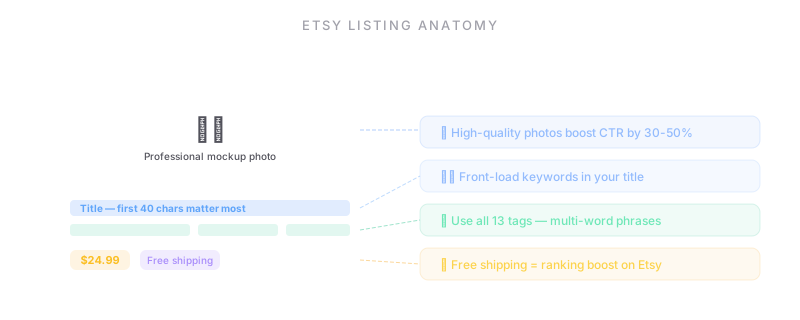
Front-load your primary keyword. Etsy gives more weight to words that appear at the beginning of your title. If your most important search term is "vintage botanical print," that phrase should be the first thing in your title — not buried at the end.
Use the full 140 characters. Etsy gives you 140 characters for your title. Use them. Each word is an opportunity to match a search query. A title like "Cat Poster" is leaving enormous amounts of traffic on the table compared to "Minimalist Cat Poster, Black Cat Wall Art, Modern Pet Print, Cat Lover Gift, Gallery Wall Art."
Structure your title as keyword phrases separated by commas. This is the pattern top-performing Etsy listings follow:
`
[Primary keyword phrase], [Secondary keyword], [Tertiary keyword], [Gift keyword], [Style keyword]
`
Example:
Avoid keyword stuffing or unnatural phrasing. "Poster Art Print Wall Decor Home" reads like spam. "Vintage Botanical Art Print for Gallery Wall" reads like a real product title. Etsy's algorithm has gotten better at detecting and penalizing unnatural keyword stuffing.
Match your title keywords to your tags. Etsy has confirmed that repeating a keyword in both your title and your tags reinforces the signal. If "boho floral poster" is in your title, it should also be one of your 13 tags.
2. Tags Strategy (All 13, Every Time)
You get exactly 13 tags per listing. Use all 13. There is no scenario where using fewer tags helps you.
Use multi-word phrases, not single words. A tag like "poster" is too broad and too competitive. "Minimalist cat poster" is specific enough to rank for and matches how real buyers search.
Think like a buyer. What would someone actually type into Etsy search? Not "feline art" — they'd type "cat wall art" or "cat print for nursery." Use the language your customers use.
Mix head terms and long-tail keywords:
| Type | Example | Competition |
|---|---|---|
| Head term | wall art | Very high |
| Mid-tail | botanical wall art | Medium |
| Long-tail | vintage botanical print cottagecore | Low |
Long-tail keywords have lower search volume but much higher conversion rates. A buyer searching for "vintage botanical print for boho living room" knows exactly what they want — and they're ready to buy.
Don't repeat words you already used in your title unless they form a different phrase. If "botanical print" is in your title, you don't need it as a standalone tag. But "botanical print set of 3" as a tag adds new value because it captures a different search query.
Include gift-related tags when appropriate: "gift for mom," "housewarming gift," "birthday gift for her." Gift searches account for a significant percentage of Etsy traffic, especially around holidays.
3. Description Optimization
Etsy's search algorithm gives minimal weight to descriptions compared to titles and tags. While descriptions may provide some context, titles and tags remain the primary ranking factors. That said, your description still matters for two important reasons:
- Google search. Google does index your Etsy descriptions. The first 160 characters of your description become the meta description that appears in Google search results.
- Conversion. A well-written description convinces browsers to become buyers, which improves your listing quality score, which improves your Etsy search ranking.
Start your description with your most important keywords in a natural sentence. Example: "This vintage botanical print features a hand-illustrated wildflower arrangement, perfect for cottagecore and boho home decor."
Include practical details buyers need: dimensions, materials, shipping times, care instructions. Answer every question a buyer might have before they ask it. Unanswered questions lead to abandoned carts.
Use short paragraphs and bullet points. Walls of text don't get read. Make your description scannable.
4. Categories and Attributes
When you create a listing, Etsy asks you to choose a category and fill in attributes (size, color, material, occasion, etc.). Fill in every single attribute available to you.
Categories and attributes serve as additional keyword signals. A buyer filtering results by "Color: Blue" will only see listings that have the blue attribute selected. If you left it blank, you're excluded from those filtered results.
Choose the most specific subcategory available. "Home & Living > Wall Decor > Prints > Digital Prints" is better than just "Home & Living > Wall Decor."
5. Listing Photos and Thumbnails
Photos don't directly affect Etsy's search algorithm, but they massively affect your click-through rate (CTR), which directly affects your listing quality score, which affects your ranking.
Your first photo is your thumbnail. It's the only thing buyers see in search results. It needs to:
- Show the product clearly against a clean background
- Be visually distinct from competitors (scroll the first page of your target keyword and make sure your thumbnail stands out)
- Use the full frame — no tiny product in a sea of white space
Use all 10 photo slots. Include lifestyle mockups, size reference shots, detail close-ups, and packaging photos. More photos = more information = higher conversion.
6. The Renewal Boost
Etsy gives newly listed and recently renewed listings a small, temporary ranking boost. This is one of the few ways to get an immediate visibility increase.
For new listings: Etsy will show your listing to a sample of searchers to gauge interest. If it gets clicks and favorites in this window, Etsy will rank it higher going forward. This means your listing needs to be fully optimized before you publish it — you don't get a second first impression.
For renewals: Renewing a listing costs $0.20 and gives a small recency boost. This is not a magic bullet, but for listings that are already performing decently, a strategic renewal during peak shopping hours can help.
Don't over-renew. Renewing a listing with poor keywords or bad photos ten times won't fix the underlying problem. Fix the listing first, then renew.
7. Shipping and Pricing
Free shipping matters. Etsy has confirmed that listings offering free shipping (especially to the US) receive a ranking boost. If your margins allow it, build shipping into your product price and offer free shipping. A $25 poster with free shipping will typically outrank a $20 poster with $5 shipping, even though the buyer pays the same amount.
Competitive pricing also matters indirectly. If your product is priced significantly higher than similar listings, your conversion rate will suffer, which hurts your quality score.
8. Etsy Ads and Organic Ranking
A common question: does running Etsy Ads help your organic ranking? The short answer is no, not directly. Etsy has stated that paid placement and organic ranking are independent systems.
However, Etsy Ads can help indirectly. If ads drive traffic to your listing and those visitors convert (buy, favorite, or click through), your listing quality score improves, which helps organic ranking over time.
Use Etsy Ads strategically: run them on your best-converting listings to amplify what's already working, not to prop up listings that don't convert organically.
Common Mistakes to Avoid
1. Writing titles for humans only, not search. "The Dreamer" is a beautiful product name. It's also completely invisible in search. No one searches for "The Dreamer." They search for "abstract landscape print blue."
2. Using single-word tags. "Blue," "poster," "art" — these are too broad to be useful. Always use multi-word phrase tags.
3. Ignoring categories and attributes. Every blank attribute is a missed opportunity to appear in filtered search results.
4. Copying competitor titles verbatim. Etsy's algorithm doesn't reward identical listings. Find your own keyword combinations based on research.
5. Changing too many things at once. If you rewrite your title, change all 13 tags, swap your photos, and adjust your price in one edit, you won't know what helped or hurt. Change one or two elements at a time and give each change at least 2-4 weeks to take effect.
6. Neglecting shop-level SEO. Your shop title, shop sections, and About page all contribute to your overall search presence. Don't leave them blank or generic.
7. Not tracking results. You can't improve what you don't measure. Use Etsy's built-in Stats dashboard to track which search terms drive traffic to your listings and which listings have the highest conversion rates.
Tools That Can Help
You don't have to do all of this manually. Several tools exist specifically to help Etsy sellers with SEO research and optimization.
eRank (Free + Paid)
The most established Etsy SEO tool. The free tier gives you keyword research, listing audits, and trend data. The paid plans ($5.99-$29.99/month) unlock more detailed analytics and competitor tracking. If you're on a budget, eRank's free tier is the best starting point for keyword research.
Best for: Keyword discovery, listing audit, free users.
EverBee (Free + Paid)
A Chrome extension that overlays sales estimates and analytics directly on Etsy search results. EverBee has analyzed over 170 million listings and provides estimated monthly sales, revenue, and keyword data. The free tier is useful; paid plans run $19.99-$29.99/month.
Best for: Competitor product research, estimating demand for a niche.
Marmalead ($19/month)
One of the original Etsy SEO tools. Marmalead provides keyword scoring, engagement data, and SEO grading for your listings. It's straightforward and focused, though it hasn't evolved as much as some newer tools.
Best for: Quick keyword scoring, simple listing grading.
Alura (Free + Paid)
A newer all-in-one tool that includes AI-powered title and tag suggestions, competitor tracking, and even Pinterest auto-pinning. Plans range from free to $69.99/month. The AI suggestions can be a helpful starting point, though you should always review and customize them.
Best for: AI-assisted optimization, sellers who want an all-in-one dashboard.
FluxCrea (Coming Soon)
FluxCrea is building an all-in-one platform for Etsy sellers that combines AI-powered listing optimization, bulk editing, and professional mockup generation. The AI Optimize feature will score your listings and suggest improvements to titles, tags, and descriptions — with the ability to apply changes in bulk across your entire shop.
Best for: Sellers who want to optimize and edit listings in one place, with integrated mockup tools.
FluxCrea is currently in development. You can join the waitlist to get early access.
Frequently Asked Questions
How long does it take for Etsy SEO changes to take effect?
Most changes take 24 to 72 hours to be fully reflected in search results. However, it can take 2 to 4 weeks to see meaningful changes in traffic patterns, because Etsy needs time to test your listing against searchers and build a quality score. Don't panic if you don't see results after 48 hours — give each change at least two weeks before evaluating.
Should I use the exact same keywords in my title and tags?
Yes, for your most important keywords. Etsy has confirmed that having a keyword phrase appear in both your title and tags reinforces the relevancy signal. For example, if "vintage botanical print" is your primary keyword, it should appear in your title AND as one of your 13 tags. Use your remaining tags for related keywords that aren't in your title.
Does Etsy penalize you for changing titles and tags frequently?
No, Etsy does not penalize you for editing your listings. However, each significant change essentially resets Etsy's quality score testing for that listing, which means there may be a temporary dip in visibility while Etsy re-evaluates. This is normal and usually recovers within a week. Avoid making changes more than once every two weeks unless you're fixing an obvious error.
Is the listing description used for Etsy search ranking?
Etsy gives minimal weight to descriptions for search ranking, but they do provide some context. Focus your keyword efforts on titles and tags — those are the primary ranking factors. Your description is also indexed by Google, so it affects your visibility in external search results. The first 160 characters are especially important because they appear as the meta description in Google search snippets.
How many keywords should I target per listing?
Focus on one primary keyword phrase and 4-6 secondary keyword phrases per listing. Your primary keyword should be front-loaded in your title and matched in your tags. Your secondary keywords fill out the rest of your title and your remaining tags. Trying to target 20 different keywords in a single listing dilutes your relevancy for all of them. It's better to create separate listings targeting different keyword clusters.
Putting It All Together
Here's a quick checklist you can use every time you create or optimize a listing:
- [ ] Primary keyword phrase is the first thing in your title
- [ ] Title uses close to 140 characters with comma-separated keyword phrases
- [ ] All 13 tags are filled with multi-word phrases
- [ ] Primary keywords appear in both title and tags
- [ ] Tags include a mix of head terms and long-tail keywords
- [ ] Most specific subcategory is selected
- [ ] All available attributes are filled in
- [ ] Description starts with a keyword-rich natural sentence
- [ ] First photo is a strong, clear thumbnail
- [ ] All 10 photo slots are used
- [ ] Free shipping is offered (if margins allow)
- [ ] Price is competitive for the category
Etsy SEO is not a one-time task. The marketplace evolves, trends shift, and competition changes. Set a recurring reminder to review your top listings once a month, check your Etsy Stats for search term data, and adjust your keywords based on what the data tells you.
The sellers who consistently rank on page one are the ones who treat SEO as an ongoing practice, not a one-time setup.
Related Articles
- Etsy Tags Guide — How to Choose the Best 13 Tags
- Etsy Listing Optimization Checklist (2026)
- Best Etsy SEO Tools in 2026
FluxCrea is building tools to make Etsy listing optimization faster and easier — from AI-powered SEO scoring to bulk editing and mockup generation. If you want to be among the first to try it, join the waitlist at fluxcrea.com/coming-soon.